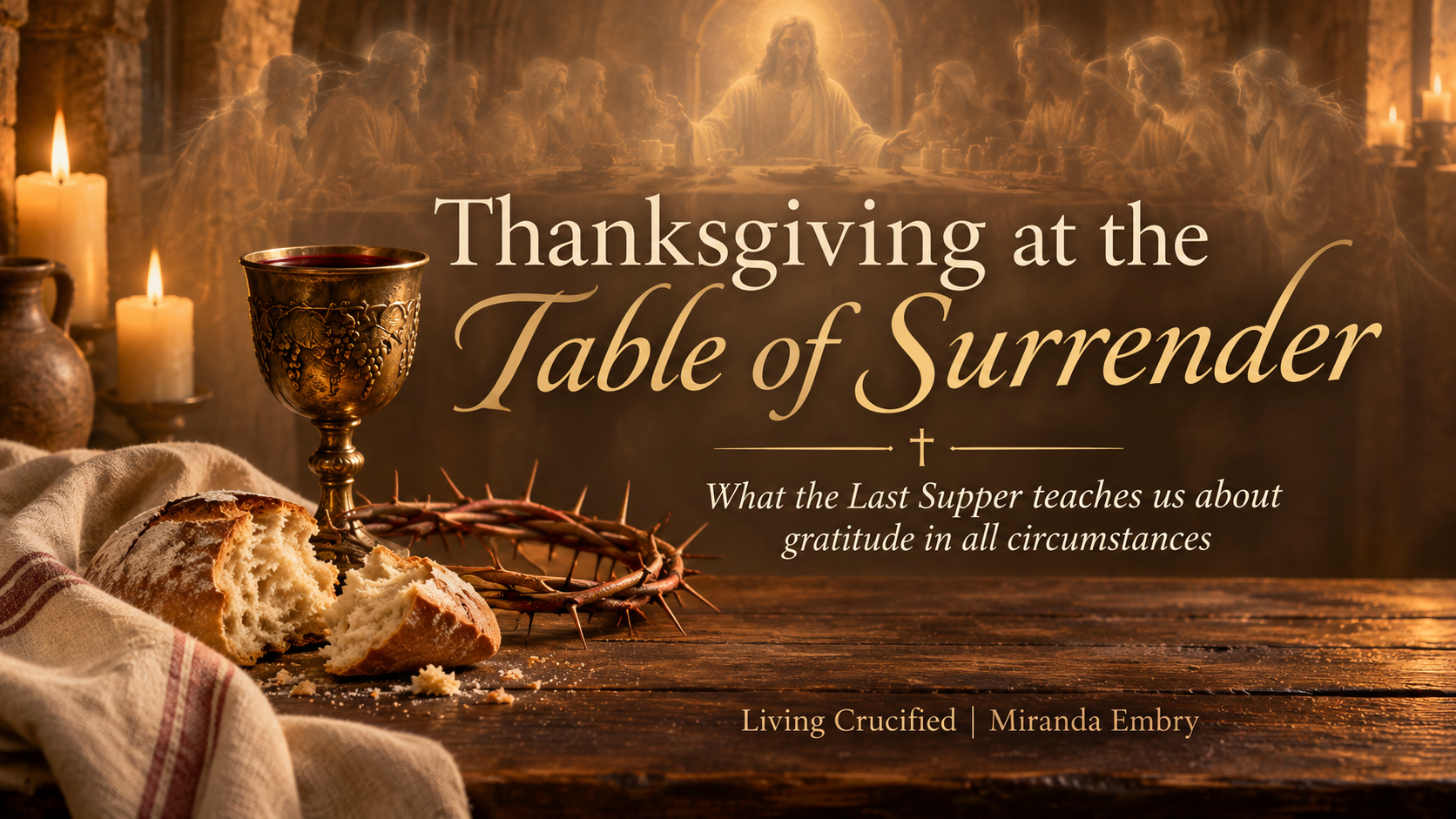
What the Last Supper teaches us about gratitude in all circumstances
Every year, we gather around our tables to share a meal, reflect on our blessings, and express gratitude for what we have received. But what if one of the most profound demonstrations of thanksgiving in Scripture occurred around a table where suffering, rather than celebration, was imminent?
On the night before His crucifixion, Jesus gathered around a table with His disciples. Knowing what awaited Him, He took bread, gave thanks, and broke it.
Before the cross, there was a table. Before the sacrifice, there was thanksgiving. And within that moment lies a powerful lesson about what it means to live crucified.
1. The Meaning of Thanksgiving
Understanding gratitude
When we hear the word Thanksgiving, we often associate it with a holiday, a gathering of family and friends, and an opportunity to reflect on our blessings. But the biblical meaning of thanksgiving extends far beyond an annual celebration.
Consider the relationship between these three terms:
Gratitude: An inward disposition of thankfulness and appreciation.
Giving thanks: The active expression of that gratitude.
Thanksgiving: The expression or offering of thanks, particularly toward God.
In Scripture, two closely related Greek words help us understand this connection.
Eucharistia (εὐχαριστία) | Strong’s G2169
A noun meaning thanksgiving, thankfulness, or the giving of thanks.
Eucharisteō (εὐχαριστέω) | Strong’s G2168
A verb meaning to be grateful, to give thanks, or to express gratitude.
It is from this Greek word family that we derive the term Eucharist, a name given to the Christian observance of the Lord’s Supper, also known as Communion. The word Eucharist itself means thanksgiving.
While the Last Supper was not the historical origin of our modern Thanksgiving holiday, the spiritual connection between the two is worth exploring. Both involve gathering around a table, sharing a meal, remembering, and giving thanks. However, while our Thanksgiving celebrations often center around the blessings we have received, the Lord’s Supper centers around the sacrifice Christ made.
One invites us to remember our blessings, while the other invites us to remember our redemption. As believers, we have an opportunity to recognize not only what God has given to us, but what Christ has given for us.
2. The Model of Thanksgiving
Examining Jesus
Luke 22:19 (NLT)
He took some bread and gave thanks to God for it. Then he broke it in pieces…
The Greek word used here for giving thanks is eucharisteō. But perhaps what is most remarkable about this moment is not simply that Jesus gave thanks, but the circumstances in which He chose to do so.
Jesus knew that betrayal was imminent, that denial and abandonment were coming, and that humiliation, rejection, physical suffering, and crucifixion awaited Him. He knew the cost of His obedience, yet He still gave thanks.
Jesus did not wait until the suffering had passed to express gratitude to the Father. He did not wait until the stone had been rolled away or until the victory of the resurrection had been revealed. He gave thanks before the suffering, not merely after the victory.
And His thanksgiving did not negate the reality of what He was about to endure. Later, in the Garden of Gethsemane, Jesus expressed the depth of His anguish while surrendering Himself to the will of the Father (Luke 22:42–44). His gratitude and His anguish were not contradictory.
Through these moments, Jesus demonstrates that thanksgiving and suffering can coexist. Gratitude does not require the absence of grief, pain, sorrow, or hardship. Nor does surrender require us to pretend that our circumstances are easy.
We can acknowledge the reality of our suffering while recognizing the goodness of our God. We can grieve and still give thanks, struggle and still surrender, and suffer and still worship.
Thanksgiving is not dependent upon the goodness of our circumstances, but anchored in the goodness of our God.
3. The Mandate of Thanksgiving
Living crucified
1 Thessalonians 5:18 (NLT)
Be thankful in all circumstances, for this is God’s will for you who belong to Christ Jesus.
The NKJV translates this instruction as:
In everything give thanks.
Interestingly, the Greek word used in this instruction is the very same verb used to describe Jesus giving thanks at the Last Supper: eucharisteō. What Jesus modeled at the table, Scripture instructs us to practice in our daily lives.
Notice that we are instructed to give thanks in all circumstances. This does not require us to be thankful for every painful circumstance we encounter. There is a difference between expressing gratitude in the midst of suffering and expressing gratitude for the suffering itself. We do not have to call evil good, minimize injustice, dismiss our pain, or deny the reality of our circumstances to cultivate a heart of thanksgiving.
But living crucified does require us to examine the conditions we have placed upon our gratitude. Have we made our thanksgiving dependent upon answered prayers, our praise contingent upon favorable outcomes, or our gratitude conditional upon God moving according to our expectations?
It is often easier to give thanks for what God has done than to give thanks for who God is when we cannot yet see what He is doing. But if our gratitude is rooted solely in what we receive, it will naturally fluctuate according to what we experience. A heart of thanksgiving rooted in Christ has a foundation that circumstances cannot remove.
His character has not changed because our circumstances have, nor has His faithfulness diminished because our suffering has increased. His goodness is not determined by our understanding of His ways.
Living crucified means surrendering our tendency to make our circumstances the determining factor in our response to God. It means allowing the truth of who He is to shape our posture of gratitude, even when our circumstances challenge it.
Gratitude is a posture of the heart, not a product of prosperity. Thanksgiving is an expression of worship, not an exemption from suffering. Surrender is a response of faith, not a denial of reality.
From a Holiday to a Heart Posture
This Thanksgiving, as we gather around our tables, share our meals, and reflect on our blessings, may we remember another table. A table where bread was broken, where Jesus spoke of the new covenant in His blood, and where He expressed thanksgiving in the face of suffering.
Before we give thanks for what fills our tables, may we give thanks for the One who gave Himself for us.
We do not have to wait for deliverance to express gratitude, for healing to recognize His goodness, or for our circumstances to change to give Him praise. The greatest reason for our thanksgiving is not found in what we possess, what we have accomplished, or even what we have overcome. It is found in Jesus Christ and the redemptive work He accomplished on the cross.
A Moment of Reflection
This Thanksgiving, instead of only counting our blessings, may we also examine the conditions we have placed upon our gratitude.
Is my gratitude rooted in God’s character or dependent upon my circumstances?
What conditions or expectations do I need to surrender to cultivate a heart of thanksgiving?
How can I intentionally express gratitude to God in the midst of my present circumstances?
May our thanksgiving extend beyond a meal, a gathering, or a date on the calendar. May it become a daily expression of our faith, a discipline of our discipleship, and a demonstration of our surrender.
Because thanksgiving is not simply something we celebrate. It is something we cultivate as we learn to live crucified.
Happy Thanksgiving, and may we remain renewed, refined, and rooted in Christ.