ROOTED IDENTITY™ METHOD BIBLE STUDY
Dig Deep for Truth. Live Rooted in Christ. Walk in the Word.
The Rooted Identity Method™ is a 16-lens inductive, neurodivergent-friendly Bible study method designed to help you uncover biblical truth, experience spiritual transformation, and establish and reinforce your identity in Christ.
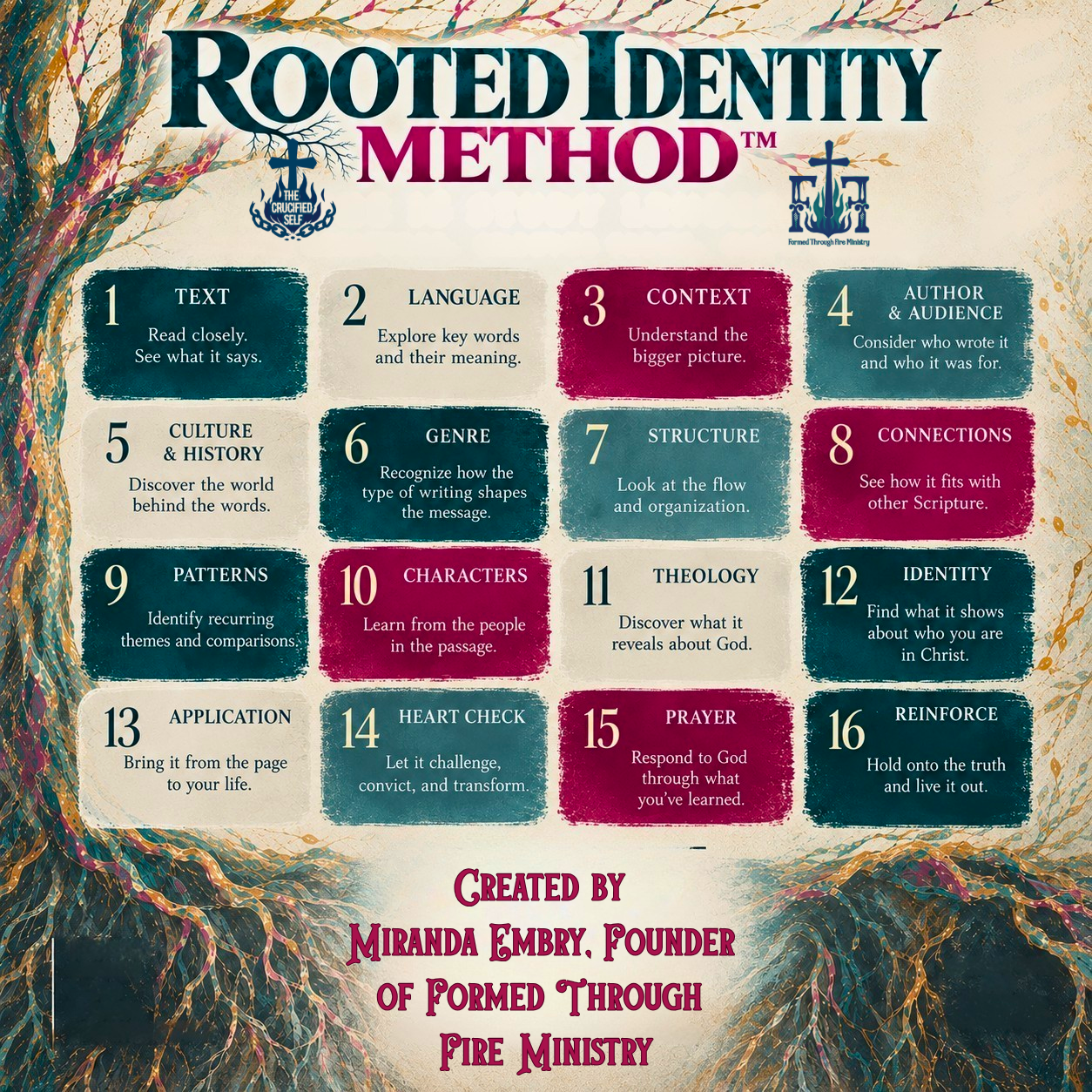
Built around a core passage, the method guides you through Scripture using 16 focused study lenses that explore what the text says, what it means in context, what it reveals about God and your identity in Christ, and how that truth should shape the way you live. But the Rooted Identity Method wasn't created simply to help you collect more information about the Bible. It was created to help you dig deeply without getting lost in the digging.
Why I Created It
As a neurodivergent Bible student and teacher, I know that deep study can be both incredibly rewarding and incredibly sprawling. My brain naturally notices connections, patterns, repeated ideas, contrasts, word meanings, questions, and implications, often all at the same time.
Traditional study formats don't always work well with that kind of processing. Some are too linear. Others leave so much open-ended space that one verse can turn into seventeen rabbit trails and three hours later you're researching ancient agricultural practices and wondering how you got there. 😆
I wanted a method that could make room for curiosity while giving it structure. The Rooted Identity Method™ was developed to do exactly that. Its 16 lenses provide defined places for the different things you may notice while studying Scripture. Instead of forcing every observation into one straight line, the method lets you examine the passage from multiple angles and then bring those discoveries together into a fuller understanding of biblical truth. That makes it especially friendly for neurodivergent learners, while remaining useful for anyone who wants a structured way to study Scripture deeply.
More Than Information
Rooted Identity is inductive at its core: observation → interpretation → application. You investigate Scripture rather than beginning with someone else's conclusions. But the goal isn't simply interpretation. It's formation. The method intentionally moves from understanding the text toward recognizing what Scripture reveals about God, identifying who you are in Christ, confronting what needs to change, and applying biblical truth to everyday life. In other words: We don't study Scripture merely to know more. We study Scripture so that truth takes root deeply enough to change how we live.
The 16 Study Lenses
Commands — What actions or responses are being instructed?
Promises from God — What has God promised?
Revelations & Insights — What truth becomes visible as you study?
Warnings — What cautions or consequences appear?
Actions of God — What is God doing, providing, accomplishing, or revealing?
Spiritual Principles — What enduring biblical principles emerge?
Metaphors — What imagery helps communicate the truth?
Choice / Decision — What response or decision is presented?
Related Verses — Where else does Scripture illuminate or reinforce this truth?
Original-Language Definitions — What do important Hebrew or Greek words reveal?
Context — Who, what, when, where, and why?
Cause & Effect — What actions, conditions, or truths lead to particular outcomes?
Identity in Christ — What does the passage reveal about who you are because of Christ?
Contrast Points — What deliberate differences or opposites sharpen the message?
Repeated Themes — What ideas, words, or patterns continue appearing?
Self / Life Application — How should this truth affect the way you think, believe, respond, and live?
Those are also consistent with the 16 categories already established in the existing material.
How It Can Be Used
The method can flex with the depth of study. You can use it with a single verse or short passage, work through an entire chapter, trace a biblical topic or theme, prepare for teaching or small-group study, or specifically explore passages concerning identity in Christ. Your existing website version already explicitly positions it for personal study, small groups, teaching preparation, topical or identity studies, and whole-chapter deep dives.
And importantly, you do not have to force every passage to produce something for all 16 lenses. The lenses are investigative tools, not boxes Scripture has to fill. If a passage contains no warning, for example, you don't manufacture one. Your existing Colossians example already demonstrates this by simply recording “None listed in this passage” under Warnings.
The Heart of the Method
Uncover Biblical Truth | Experience Spiritual Transformation | Establish & Reinforce Identity in Christ
The Rooted Identity Method™ gives your curiosity somewhere to go, your discoveries somewhere to belong, and biblical truth somewhere to take root.
Dig Deep for Truth.
Live Rooted in Christ.
Walk in the Word.
Rooted Identity Method™ Example: Colossians 1:20–23a (NLT)
1. Commands
Continue to believe the truth and stand firmly in it.
2. Promises from God
Through Christ, we have been reconciled to God and brought into His presence holy and blameless.
3. Revelations & Insights
Those who were once separated from God can be reconciled to Him through Christ’s death.
4. Warnings
Do not drift away from the assurance of the Good News you received.
5. Actions of God
God made peace through Christ’s blood, reconciled us through Christ’s death, and brought us into His presence.
6. Spiritual Principles
Reconciliation and transformation come through Christ and His work on the cross, not through our own efforts.
7. Metaphors / Imagery
Alienation and reconciliation portray the movement from separation and hostility toward restored relationship with God.
8. Choice / Decision
Continue in faith, standing firmly in the truth rather than drifting away from the hope of the gospel.
9. Related Verses
Romans 5:10; 2 Corinthians 5:17–21; Ephesians 2:13; Hebrews 10:22–23.
10. Greek Definitions
Reconciled — apokatallassō: to reconcile completely; restore a relationship.
Holy — hagios: sacred, set apart.
Blameless — amōmos: without blemish.
11. Context
Written by Paul to believers in Colossae. In this section, Paul is emphasizing the supremacy and reconciling work of Christ and reminding believers of what Christ has accomplished for them.
12. Cause & Effect
Christ’s physical death → reconciliation with God.
Reconciliation → presented holy and blameless before Him.
Continuing in faith → standing firm rather than drifting from the hope of the gospel.
13. Identity in Christ
We were once alienated from God, but through Christ we are now reconciled, brought into His presence, holy and blameless before Him.
14. Contrast Points
Alienated → reconciled
Enemies → brought into His presence
Drifting → standing firm
15. Repeated Themes
Reconciliation, Christ’s death, faith, truth, hope, and standing firm.
16. Self-Application
Do I live from the reality that I have been reconciled to God, or do I still approach Him as though I am far away? Am I firmly grounded in the truth of the gospel, or am I easily moved by circumstances?
© 2026 Miranda Embry. Rooted Identity Method™ is an original Bible study method developed by Miranda Embry for Formed Through Fire Ministry. All rights reserved.