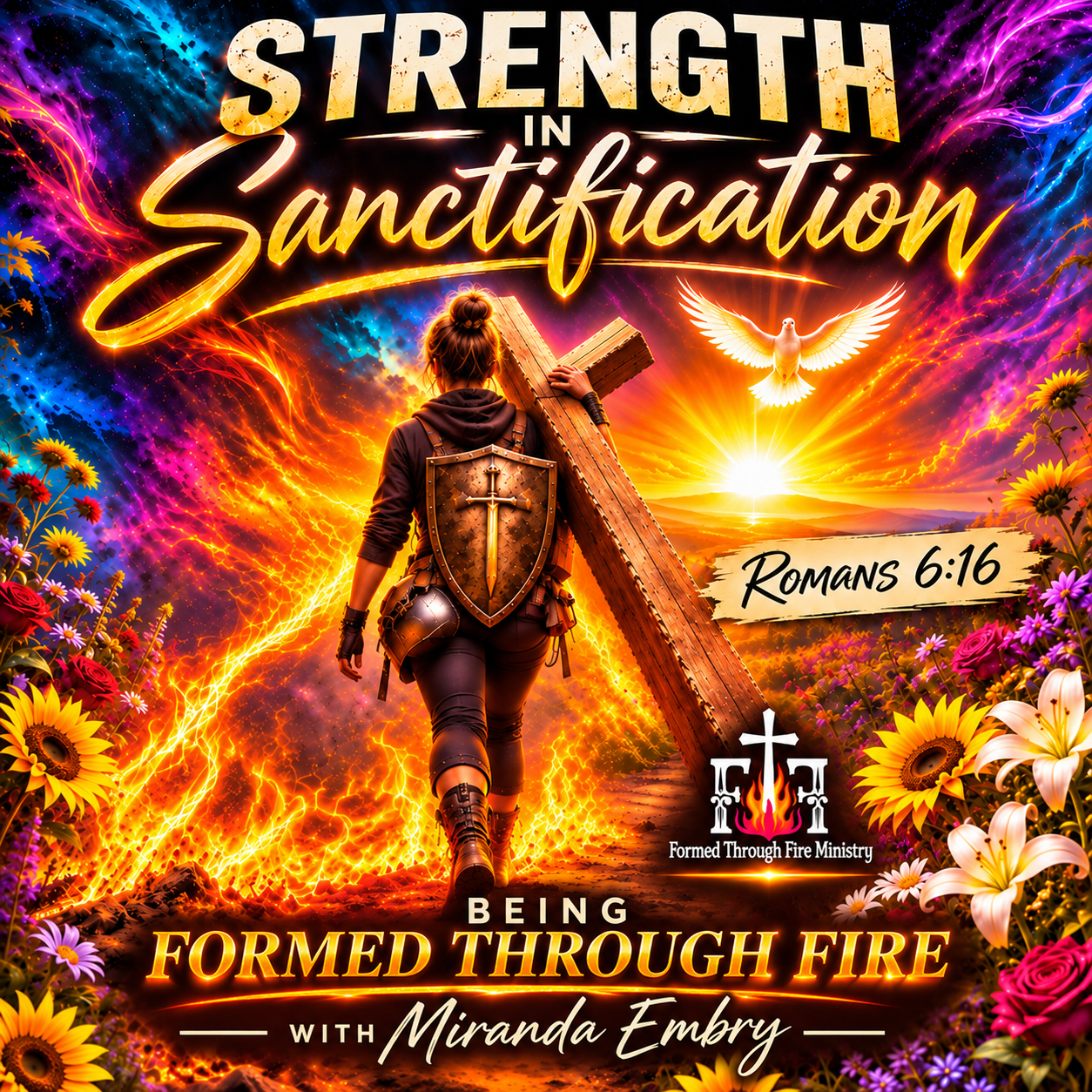
Series Scripture: Romans 6:16 - “Don’t you realize that you become the slave of whatever you choose to obey? You can be a slave to sin, which leads to death, or you can choose to obey God, which leads to righteous living.”
What if becoming more like Christ requires us to confront more than the sins we recognize? What if some of the greatest obstacles to our spiritual growth are the beliefs we’ve accepted, the behaviors we’ve justified, and the strongholds we’ve learned to live with?
Welcome to Strength in Sanctification, a new weekly teaching series from Formed Through Fire Ministry, where we’re digging into what biblical sanctification really means and what it looks like when God’s Word moves beyond what we know into how we actually live. This isn’t about religious performance, perfect appearances, or learning how to become a better version of ourselves. It’s about the transforming work of the Holy Spirit, the surrender of our flesh, and the ongoing process of becoming more like Jesus Christ. We’re ripping off the masks of who we think we should be and learning to walk in who God has called us to be.
The Foundation: Who or What Are We Obeying?
Our series is anchored in Romans 6:16, where Paul confronts the relationship between obedience and what we allow to govern our lives. Within the broader context of Romans 6, Paul explains that believers have been united with Christ in His death and resurrection and are no longer obligated to live under sin’s dominion. Grace does not give us permission to remain enslaved to the very things Christ has freed us from. Instead, it establishes a new relationship with God and calls us into a life increasingly characterized by righteousness and obedience.
This raises a question that will follow us throughout the series: Who or what are we actually obeying? We can profess faith, understand biblical principles, and sincerely desire to follow Christ while continuing to defend attitudes, entertain beliefs, or repeat behaviors that contradict His Word. The challenge of sanctification is not merely knowing what obedience requires, but recognizing where our lives are still being governed by something other than Christ. And that requires examination, surrender, and a willingness to be changed.
What Is Biblical Sanctification?
The New Testament uses the Greek word hagiasmos in connection with holiness and sanctification, communicating the idea of being set apart to God. 1 Thessalonians 4:3 identifies sanctification as God’s will for His people, while 1 Thessalonians 5:23–24 emphasizes His faithful work of sanctifying believers completely.
To understand sanctification, it helps to distinguish three related aspects of salvation:
Justification concerns our righteous standing before God through faith in Jesus Christ.
Sanctification involves being set apart to God and growing in holiness as the Holy Spirit transforms us into greater conformity to Christ.
Glorification is the future completion of that transformation. Sanctification is not an attempt to earn salvation through good behavior, nor is it a spiritual self-improvement project. Its purpose is Christlikeness.
Romans 8:29 identifies conformity to the image of God’s Son as central to His purpose for believers. And here’s where the distinction becomes personal: we aren’t called to simply make our flesh appear more Christian. We’re called to surrender it. Philippians 2:12–13 reminds us that God works within believers both to will and to act according to His purposes. Our responsibility to pursue obedience exists alongside our dependence upon His power. We participate through repentance, surrender, faith, and obedience, but genuine spiritual transformation is not manufactured through human willpower alone.
Why Does Sanctification Matter?
Because salvation was never intended to leave us unchanged…
We can learn biblical terminology, memorize Scripture, attend church, serve in ministry, and become exceptionally skilled at appearing spiritually mature while remaining bound by beliefs and patterns that contradict God’s truth. Religious activity and spiritual formation are not automatically the same thing. Ephesians 4:22–24 describes putting off the old self, being renewed in our thinking, and putting on the new self. This is not simply a call to modify outward behavior. It involves the renewal of our inner life and the development of conduct consistent with our new identity in Christ.
Sometimes the areas requiring the greatest transformation are not immediately obvious. Pride can disguise itself as righteousness. Fear can influence our decisions without our awareness. Resentment can become so familiar that we begin treating it as justified truth. Insecurity can shape how we evaluate ourselves and others, while deeply rooted beliefs can govern our responses long after we’ve consciously rejected them. This is why biblical self-examination is so important. We must be willing to bring our beliefs, motives, attitudes, and behaviors before the truth of God’s Word. We cannot intentionally surrender what we refuse to acknowledge.
Sanctification involves recognizing what needs to change, understanding what is influencing it, and learning to respond through Spirit-empowered obedience.
Where Does Sanctification Intersect with Everyday Life?
Everywhere. Literally. Sanctification reaches into our relationships, thought patterns, emotions, habits, decisions, physical experiences, and responses to the world around us. We do not experience spiritual formation in isolation from the realities of being human. Throughout Strength in Sanctification, we’ll examine our teaching subjects through four interconnected disciplines, always maintaining Scripture as the governing foundation.
Theology: What Does God’s Word Say?
Theology establishes our biblical foundation. We’ll examine Scripture in context, explore doctrinal truths, and investigate what God’s Word teaches about sin, righteousness, repentance, obedience, spiritual warfare, sanctification, and the character of Christ. Our objective is not to make Scripture support our preferred conclusions, but to allow Scripture to examine and correct what we believe.
Physiology: What Is Happening in the Body?
Our physical bodies influence how we experience daily life. Hormones, illness, stress responses, physical limitations, fatigue, and other biological processes can affect our experiences and responses. Understanding physiology allows us to examine these realities with greater accuracy rather than automatically assigning spiritual explanations to every physical experience.
Neurology: What Is Happening in the Brain and Nervous System?
Our brains and nervous systems are involved in how we process information, develop habits, experience emotions, and respond to situations. Learned patterns can become deeply established, influencing our reactions and decisions. We’ll explore relevant neurological principles to better understand these processes and how they intersect with personal responsibility, spiritual growth, and practical discipleship.
Philosophy: What Do We Believe, and Why?
Every person operates from beliefs and assumptions about identity, worth, purpose, truth, and human nature. Some are consciously established, while others develop through experiences, relationships, and repeated interpretations. We’ll examine how these underlying philosophies influence our worldview and evaluate them through biblical truth. Theology establishes what God has revealed. Physiology and neurology help us understand aspects of our physical and cognitive experiences. Philosophy helps us examine the assumptions influencing how we interpret those experiences.
Our objective is not merely understanding ourselves better. It is allowing biblical truth to shape how we live.
Three Recurring Themes: Think, Feel, Act
One framework you’ll encounter repeatedly throughout this series is the relationship between the mind, emotions, and will, expressed through the practical cycle of Think → Feel → Act. We’ll also explore the biblical whole-person framework of Spirit → Soul → Body, recognizing these as connected teaching lenses rather than interchangeable definitions. These connections help us examine how God’s transforming work reaches our inner life and becomes evident in our outward conduct.
1. THINK | Mind | Spirit
Romans 12:2
What we believe influences how we interpret ourselves, other people, and the world around us. Our thoughts can be shaped by Scripture, but they can also be influenced by assumptions, experiences, fears, and deeply rooted beliefs. The renewal of the mind involves allowing God’s truth to confront and transform patterns of thinking that do not align with His Word. A recurring question throughout this series will be: What am I believing, and does that belief align with Scripture?
2. FEEL | Emotions | Soul
Psalm 139:23–24
Our emotions are part of our human experience. They can reveal expectations, fears, wounds, desires, and underlying beliefs that deserve examination. Feelings are real experiences, but they do not independently establish truth. We can acknowledge what we feel while examining what those feelings may be communicating. Rather than ignoring our emotions or automatically obeying them, we can learn to bring our inner experiences before God with honesty. Our recurring question becomes: What am I feeling, and what might it be revealing within me?
3. ACT | Will | Body
Romans 6:12–13
Our will is involved in the decisions we make, and our actions express how we choose to respond to the thoughts, emotions, and convictions we experience. Knowing what Scripture teaches does not automatically mean we’re living according to it. Sanctification calls us to move from understanding into obedience, relying upon the Holy Spirit rather than merely reacting from familiar patterns. Our recurring question becomes: What am I choosing to do with what I think and feel?
The Connection Between Our Inner Life and Our Responses
What we think influences how we feel. What we feel can influence how we act. These processes interact, sometimes reinforcing beliefs and reactions we’ve carried for years. But our emotional responses do not have to determine our choices. Through surrender to Christ, we can learn to respond according to God’s truth rather than simply following an immediate reaction. The evidence of surrender isn’t necessarily the absence of an emotional reaction. It’s accepting responsibility for what we choose to do with that reaction. This principle will appear throughout our discussions of strongholds, spiritual warfare, emotional responses, personal responsibility, and the ongoing work of sanctification.
How Will We Approach This Journey?
Through biblical teaching, honest examination, practical application, and lived experiences.
Every episode will explore an area connected to sanctification, including spiritual strongholds, areas of strength, beliefs, emotional responses, habits, spiritual warfare, obedience, and the promises and instructions of God’s Word. We’ll examine both the areas of flesh that require surrender and the areas of spiritual growth God is developing within us. Personal testimony will also play an important role. I’ll be sharing experiences from my own life, including patterns I’ve had to confront, beliefs I’ve had to reconsider, and lessons God continues to teach me through His Word. I’m not approaching this series as someone who has completed the process of sanctification. I’m walking through it, too.
James 1:22–25 offers a powerful illustration of someone looking into a mirror but failing to respond to what they have seen. That image captures a central purpose of this series: biblical truth must move beyond recognition into application. We aren’t simply learning to identify what needs transformation. We’re learning to surrender to the One who transforms us.
When and Where Can You Follow the Series?
Strength in Sanctification releases every Saturday at 7 PM Central Time through the Formed Through Fire Ministry YouTube channel, our Facebook Community and here on the website. We’ll begin with recorded video teachings, with the possibility of incorporating live teaching or discussion opportunities in the future. (you decide…)
Each episode will include three complementary resources:
Video Teaching: A recorded lesson exploring the subject through Scripture, relevant interdisciplinary insights, and testimony.
Lesson Handout: A companion resource with biblical references, important teaching points, reflection questions, and practical application.
Website Teaching Post: A written teaching designed for further study, accessibility, and ongoing reference.
These resources are designed to support continued study and reflection beyond the release of each video. Spiritual formation is not limited to a weekly teaching. It is lived out through the choices, responses, and acts of obedience that follow.
The Invitation: Stop Performing and Start Surrendering
Sanctification is not about perfecting a religious image. It’s not about appearing spiritually mature while hiding the very areas God is calling us to surrender. And it’s certainly not about measuring our worth by how well we perform. It’s about becoming increasingly conformed to Christ through the transforming work of the Holy Spirit.
Throughout this series, we’ll confront uncomfortable truths, identify strongholds, recognize areas of strength, examine our beliefs and behaviors, and explore the promises and instructions of Scripture. We’ll challenge the identities we’ve constructed, the expectations we’ve accepted, and the patterns we’ve allowed to govern our lives. We’re ripping off the masks of who we THINK we should be and walking into who GOD HAS CALLED US TO BE!
Not through performance. Not through pretending. And not through the strength of our own flesh. Through surrender, obedience, and the power of the Holy Spirit. So as we begin this journey, I want to leave you with the question that will remain at the center of every teaching: Who or what are you actually obeying? Because sanctification isn’t about learning how to look refined. We’re called to BE refined. And that’s what it means to be Formed Through the Fire.
Coming Next: Episode 1
When the Window Is Really a Mirror
What if the problem you’re seeing so clearly in someone else is actually something God is trying to show you about yourself? Our first episode will explore the connection between perception, biblical self-examination, and the strongholds we may unknowingly recognize in others before recognizing them within ourselves. New episodes every Saturday at 7 PM Central Time.
Strength in Sanctification
Being Formed Through the Fire with Miranda Embry
Romans 6:16