“Rooted in Christ: Identity, Freedom, and New Life” Week 4 – Reconciled Through the Cross
Colossians 1:21–23 (AMP)
1. Key Passage
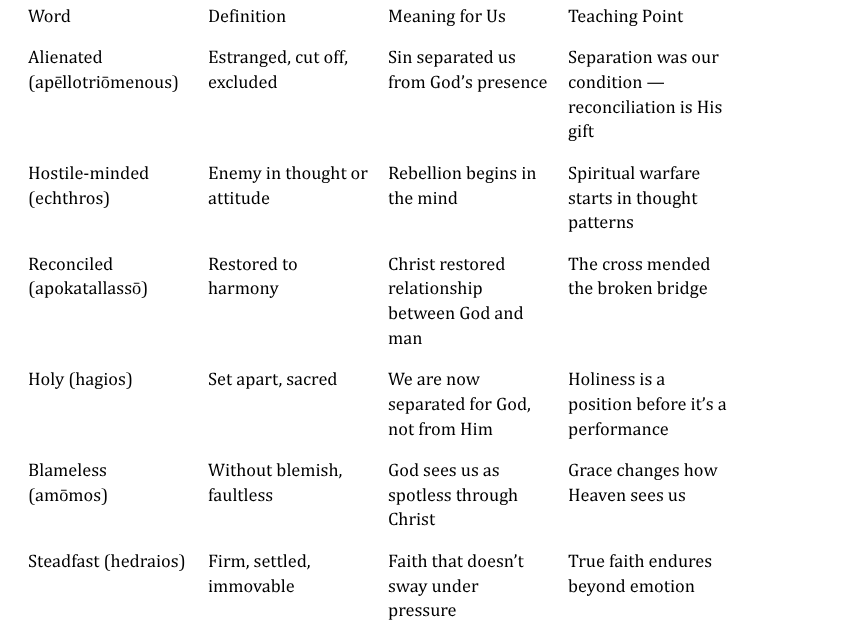
And although you were at one time estranged and alienated and hostile-minded toward Him, participating in evil things, yet Christ has now reconciled you [to God] in His physical body through death, in order to present you before the Father holy and blameless and beyond reproach [and He will do this] if indeed you continue in the faith, well-grounded and steadfast, and not shifting away from the confident hope [that is a result] of the gospel that you have heard, which was proclaimed in all creation under heaven, and of which [gospel] I, Paul, was made a minister.
2. Context Breakdown
Who: Paul reminds the believers of their before-and-after transformation — from alienated sinners to reconciled saints.
When/Where: ~AD 60–62 from prison, continuing his argument for Christ’s supremacy and sufficiency.
To Whom: The Colossians, some of whom were being told that they needed extra rituals or mediators to stay in God’s favor.
Why: To anchor them in the truth that reconciliation with God is already finished and complete through Christ’s death.
Theme Focus: You were once alienated — now reconciled. Christ’s work on the cross brings peace, purity, and perseverance.
3. Keyword Study (Greek)
4. Cross-References
• Reconciliation: Romans 5:8–11; 2 Corinthians 5:18–19
• Holiness & Blamelessness: Ephesians 1:4; Jude 24–25
• Perseverance in faith: Hebrews 10:23; 1 Corinthians 15:58
• Hope of the gospel: Titus 2:13; 1 Peter 1:3–5
5. Grammar & Literary Observations
The passage forms a contrast between who we were and who we are now. “Yet now” (v.22) marks the turning point — the divine reversal of human separation. Paul uses courtroom language (“beyond reproach”) to emphasize our new standing before God — acquitted and accepted.
6. Spiritual Principles & Doctrinal Truths
• Sin didn’t just make us guilty — it made us enemies of God.
• Reconciliation isn’t mutual; God initiated it through the cross.
• Holiness is both a gift and a calling.
• Faith must remain steadfast; wavering faith leads to drifting hope.
• The gospel that saves is the same gospel that sustains.
7. Modern-Day Relevance
Our culture celebrates “self-reconciliation” through therapy, mindfulness, and self-love, but Paul reminds us that true peace comes only through Christ’s blood.
Many believers feel distant from God because of guilt or failure — yet Paul says, you are already reconciled.
The greatest spiritual warfare today is often identity warfare — forgetting what the cross accomplished.
In a world shifting its moral compass daily, steadfast faith is countercultural holiness in action.
8. Spiritual Warfare Insight
• Lie: You’ve messed up too much to be right with God. Truth: The cross already reconciled you — you are holy, blameless, and beyond reproach.
• Lie: You need to earn your way back to God. Truth: Reconciliation is received, not achieved.
• Lie: Faith that wavers disqualifies you. Truth: God strengthens steadfastness through endurance, not perfection.
9. Layered Life Application
Truth: Christ’s reconciliation changes our standing, identity, and perspective.
Challenge: Stop defining yourself by your past estrangement and start living as reconciled.
Call to Change: Practice walking in your new position — holy, blameless, and firm in hope.
10. Discussion Questions
• What does reconciliation through the cross mean to you personally?
• How does it change the way you approach guilt or shame?
• What does it look like to remain “steadfast and unmovable” in today’s culture?
• How can you remind yourself daily that you are blameless before God?
11. Promises & Power
• You have been reconciled through Christ’s physical death (v.22).
• You are presented holy, blameless, and beyond reproach before God (v.22).
• You are called to remain grounded and steadfast in faith (v.23).
• The gospel that saved you continues to strengthen you.
12. Weekly Action Items
• Write a declaration beginning with “I am reconciled…” and list what that means in your daily life.
• When guilt or shame arises, respond aloud with truth from Colossians 1:22.
• Take one practical step this week that reflects your reconciled identity — forgive someone, restore peace, or show mercy.
13. Spirit-Led Reflection
Reconciliation isn’t about God moving closer to you — it’s about realizing He already has. You don’t have to climb back into His favor; you were carried there by His grace. The cross was not just substitution — it was invitation. You are not tolerated; you are treasured.
14. Final Declaration
I was once alienated, but now I am reconciled through the blood of Jesus. I stand holy, blameless, and steadfast in faith. I will not shift from the hope of the gospel, for Christ has made peace between my heart and Heaven.
15. Closing Prayer
Father, thank You for reconciling me to Yourself through the cross. Thank You that I am no longer alienated, but accepted — no longer an enemy, but a beloved child. Help me to stand firm in faith and never drift from the hope of the gospel. Let my life reflect the peace You purchased. In Jesus’ name, Amen.